 |
207 SQUADRON ROYAL AIR FORCE
HISTORY
|
 |
Were you at the 60th Anniversary Reception of the Squadron held at RAF Northolt on 20th November 1976?
Peter Goodman, CO at the time recalls that it was held in the old South Side building used postwar as a terminal by BEA. All tasking was suspended for the day - just as well as the jollifications went on for several hours.
Former COs David Dick (63-64), Bill Robertson (59-61) and Hetty Hyde (40-41) were also among the guests.
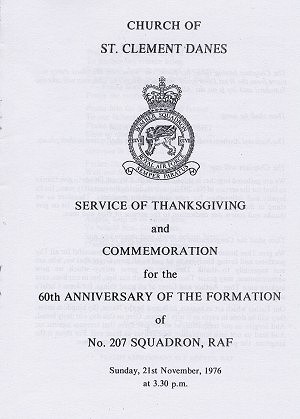
All the Devons were lined up and Squadron & guests photos were taken. The following day there was a special service in St Clement Danes.
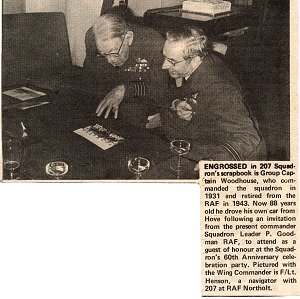
Engrossed in 207 Squadron's scrapbook is Group Captain Woodhouse who commanded the squadron in 1931 and retired from the RAF in 1943. Now 80 years old he drove his own car from Hove following an invitation from the present commander Squadron Leader P Goodman RAF, to attend as a guest of honour at the Squadron's 60th Anniversary celebration party. Pictured with the [Group Captain] is Flt Lt Henson, a navigator with 207 at RAF Northolt.
|
 Please contact the editor if you have any memories or material on this event images source: 207 Sqn Archive |
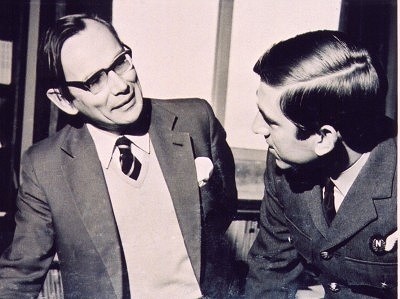 |
Lord Tedder,
the 2nd Baron, John Michael Tedder MA ScD PhD
discusses with Sqn Ldr Michael Perrett
OC 207 Squadron (4/77-2/79) a souvenir copy of the
'first day cover' flown by the Squadron to
commemorate the 60th Anniversary of its formation. Lord Tedder, son of MRAF Lord Tedder of Glenquin, kindly agreed to sign a number of covers in recognition of his late father's connection with and affection for the Squadron, which he commanded as a Sqn Ldr from Feb 1920 to July 1923. |
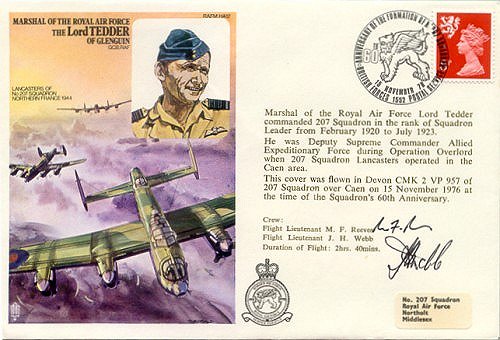
At the RAF Club on 22.7.78 Flt Lt Elder presented a cheque for £3165 to the then CAS, Sir Michael Beetham KCB CBE DFC AFC, for the RAF Museum Appeal Fund. This was the balance of the funds realised on the first day covers flown by the Squadron on 15.11.76.
source: Raymond Glynne-Owen
On the back of the envelope there was a No.207 Squadron RAF date stamp 15th November 1976 and a sticker of a Lancaster in 1942 KM-B (44 Sqn). Inside was a card with the following text:
MARSHAL OF THE ROYAL AIR FORCE LORD TEDDER OF GLENGUIN, GCB, RA, DCL, LLD
Arthur William Tedder, a Cambridge history graduate, like so many of his contemporaries entered The Royal Flying Corps from the Army, in which he had been commissioned in the Dorsetshire Regiment in 1914. He is reputed to have flown solo on his first day of flying training and to have been posted to France with only 15 hours air experience.
He served with distinction on
the Western Front and in Egypt and was mentioned in
despatches three times. At the end of the war he was granted
an RAF permanent commission with the rank of Squadron Leader.
Tedder held a variety of posts during the next fifteen years;
he commanded 207 Squadron in Constantinople, spent a year at
the Royal Naval Staff College, Commanded No. 2 Flying
Training School, worked at the Air Ministry, joined the
Imperial Defence College in 1928, was appointed to the
directing staff of the RAF Staff College in 1929 and three
years later took up the post of commander of the Air Armament
School at Eastchurch. Throughout these years Tedder's innate
gift for leadership shone through.
In 1934 Tedder was appointed Director of Training, a
particularly responsible post since plans were afoot for the
expansion of the RAF. He subsequently became Air Officer
Commanding, RAF Far East, and then Director General of
Research and Development at the Air Ministry. With the rank
of Air Marshal he was made Deputy to the AOC-in-C, RAF Middle
East and a year later, in 1941, was himself appointed to that
most senior post. In the following years was to reach the
height of his fame, first as Air Commander-in-Chief,
Mediterranean Air Command and then, in 1944-45, as Deputy
Supreme Commander under General Eisenhower, who had
recognised and supported his insistence on the over-riding
importance of Air Supremacy.
At the end of the war Tedder was promoted Marshal of the
Royal Air Force and was created a baron. Until 1949 he was
Chief of the Air Staff, and until 1950 was First and Senior
Air Member of the Air Council. From then until 1951 he was
Chairman of the British Joint Services Mission in Moscow, and
UK representative on the Military Committee of NATO.
Following his retirement from the RAF Lord Tedder remained
active in public life, notably as a Governor of the BBC,
Chancellor of Cambridge University, and President of Standard
Triumph International Ltd. A popular leader, Lord Tedder was
always interested in the welfare of RAF personnel and their
dependants, and was a President of the Royal Air Forces
Association. Lord Tedder, one of the great British commanders
of the Second World War, died in 1967 at the age of
seventy-seven.