'A Bent Sixpence'
The editor is grateful to Mr Ron Ravenhall for providing this story. In 2006 he was a local councillor in Rugby. At the time of the events below he was a ten year old English boy living in Hilversum:
"I was woken by an almighty explosion at five minutes past two on that morning of the 13th May, 1943 and so was every other person living in the town of Hilversum in occupied Holland, as windows were blasted out by an enormous explosion and a spectacular fireworks display in the sky. My mother, my two sisters and I dashed outside our little cottage and watched in horror as the fragments of an aeroplane came down to earth, falling like hailstones. In the morning, small pieces of aluminium and human bodies littered the area, including gruesome finds like a boot containing a leg, a flying helmet with an ear in it, a knee and fingers.
But my mother found an article in our back garden that she treasured for the rest of her long life - a sixpence, bent almost double by the force of the blast, that came out of the pocket of one of her brave young fellow-countrymen.
As a ten year-old English boy, the event made a lasting impression on me, but there were many others during the five years of the occupation, at the mercy of the Gestapo, starving during the ‘Hunger Winter’ of 1944, with my father in a Nazi concentration camp. Eventually we were liberated and I returned to England, where at the age of 19-20, I served with immense patriotic pride, as Flying Officer (2572375), Assistant Adjutant on No.605 Fighter Squadron, RAF Honiley, during my National Service.
It was not until I became acquainted with Mr George Fisher, 62 years after that event in my childhood, that he inspired me to research the course of events that led to the catastrophe of that May night in 1943.
The previous evening of the 12th May, 1943 was fairly routine for 207 Squadron at the rural airfield of RAF Langar, some 10 miles SE of Nottingham. Another raid was planned to Duisburg in the Ruhr and Lancaster ED418 EM-G was being fuelled for the operation. It was an 'old crate', having already notched up 230 hours in its log book.
Its crew was:
| Pilot
Officer William Dick Hawkes RAFVR - Pilot, 26 Sgt Edward Stanley Tompkins RAFVR - Flight Engineer, 21 Sgt George Robert Nipper RAFVR - Bomb Aimer, 28 Sgt Arthur Wilson Whiteoak RAFVR - Navigator, 32* WO2 William Archibald McNair RCAF - Wireless Operator/Air Gunner, 20 Flt Lt Albert Douglas Coldicott DFM RAF - Air Gunner, 23 Sgt Joe Smith RAFVR - Air Gunner, 26 Sgt Hugh Robert Dick RAFVR - 2nd Navigator, 22* |
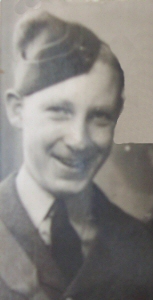 Edward Stanley Tompkins via his nephew, Ray Lester |
They assembled for the briefing that evening. The pilot, Dick Hawkes, had been to Duisburg before on two occasions without mishap. He was already an old hand, having survived fourteen ops, whereas the average was four. It would not be a long trip - two hours there and two hours back, but the weather report was not good. It was cloudy over England, but clear on the other side of the Channel and there was a strong 60 knot SW wind to contend with - behind them on the way out, but against them coming home.
Flak might be a problem, but in cloudless skies over the Netherlands, German night fighters would certainly be a menace. Duisburg was to be reached by 0205 and Pathfinder Mosquitoes would light up the target ahead of them. Since 207 Squadron had the reputation of bombing very accurately, they would lead the way. The fires they created would enhance target visibility for the rest following them.
In total, 572 aircraft would take part in the raid, including nine from 207 Squadron. Arthur Whiteoak, the Navigator, calculated that the Lancaster would need to take off at 0019 to reach the target on time.
At precisely 19 minutes past midnight Dick Hawkes opened the throttles and the Lancaster took off carrying its 1000 kilo bomb and masses of firebombs. With the wind behind them, they achieved 212 knots and twenty minutes later they left the English coast behind them. At 0115 they reached the Dutch coast and around Amsterdam the sky was lit up with searchlights. Though flak speckled the moonless night, it caused no major problems.
That good fortune was not to last. The raid suffered a major attack over the Dutch town of Apeldoorn by twin-engined Junkers 88 night fighters and at 0140 Hawkes’ Lancaster was hit. No doubt, he took evasive action and Archie McNair, Doug Coldicott and Joe Smith, the air gunners would have been busy trying to down their attacker.
Though we don’t know how badly the Lancaster was damaged, it had probably lost an engine and the damage was too severe for the Lancaster to do anything else but abort its mission and try to limp back to England. Hawkes therefore did a U-turn, descended to below 700 feet to avoid German radar and for the next twenty minutes struggled with the controls. Flying into the strong wind, his crippled plane would not have been capable of more than about 75 knots. He knew he was over built-up, residential areas and could not drop his bomb load to lighten the plane.
Just before he reached the town of Hilversum, he may have been attacked again. Fellow fliers reported a Junkers 88 in that area. There was also flak, but it is possible that the Lancaster had been on fire all along. It was certainly spotted on fire over Hilversum by eye witnesses before it exploded.
The dramatic end came with a cataclysmic explosion of its 1000 kilo bomb at precisely 02.05 and the Lancaster and its crew were blown to kingdom come. Eight young men had sacrificed their lives for the future of mankind.
The German army treated the remains with great respect. The largely intact bodies of Hawkes, Tompkins and Smith were given individual graves in the De Rusthof cemetery [Amersfoort (Oud Leusden) General Cemetery] in the town of Amersfoort and the rest of the remains were gathered and buried in a collective grave alongside. The Germans were unaware that the normal complement of a crew of seven had been augmented by a 2nd Navigator on board.
The raid was a great success and the last over Duisburg. Of the 572 bombers that took off, 479 actually reached the target, but 34 never returned. 207 Squadron lost 2 planes that night.
| The ED418 war graves are
immaculately kept.
Like me, the people of the Netherlands will never forget their indebtedness to the thousands of gallant young fliers who died that they might live and will continue to honour those who survived the unparalleled heroism of their youth. When my mother died the bent sixpence was buried with her. |
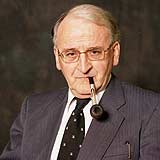 |
Ron Ravenhall - with deepest gratitude for the lives of the crew of Lancaster ED 418 EM-G, 207 Squadron, 5 Group, Bomber Command; to George Fisher for inspiration and research; for Incident in Het Rode Dorp, by Egbert Pelgrim; and to the Hilversum Council archivist. [the original article has been edited]
====
According to WR Chorley's RAF Bomber Command Losses of the Second World War (Midland Counties), in the volume for 1943:
Believed shot down by a night-fighter, coming down 0202 between Hilversum and 's-Graveland (Noord Holland) [the map happens to focus on 's-Graveland]. All are buried in Amersfoort (Oud Leusden) General Cemetery. F/L Coldicott won his DFM, Gazetted 26 April 1940, for exceptional coolness during anti-shipping operations off Norway. Sgt Whiteoak was flying as the aircraft's second Navigator*.
====
William Dick Hawkes was a pupil of Soham Grammar School, Cambridgeshire [the school the website editor attended]. He is on their Roll of Honour. Before joining the RAF he was on the staff of Shire Hall, Cambridge (Cambridgeshire County Council) and is also on their Roll of Honour. He is also commemorated in Swaffham Prior Cambridgeshire, where he grew up.
In 2010 a copy of the 1929 Soham Grammar School school photo was discovered, scanned and added to the Soham Grammarians website. Dick Hawkes has been identified on part 4/10 of that photo.
He is also has an Undying Memory page.
====
According to the Bomber Command War Diaries (Middlebrook & Everitt: Penguin, 1990):
DUISBURG 12/13 May 1943
572 aircraft took part - 238 Lancasters, 142 Halifaxes, 112
Wellingtons, 70 Stirlings, 10 Mosquitoes.
34 aircraft were lost - 10 Lancasters [including two from 207 Squadron],
10 Wellingtons, 9 Halifaxes, 5 Stirlings; 5.9% of the force.
This was the fourth raid on Duisburg so far during the Battle of the Ruhr, the first 3 raids having been only partially successful. The Pathfinder marking on this night, however, was near perfect and the Main Force bombing was particularly well concentrated. The centre of Duisburg and the port area just off the River Rhine, the largest inland port in Germany, suffered severe damage. 1,596 buildings were totally destroyed and 273 people were killed. 4 of the August Thyssen steel factories were damaged. Nearly 2,000 prisoners of war and forced workers were drafted into Duisburg to repair windows, roofs and other bomb damage. In the port area, 21 barges and 13 other ships totalling 18,921 tons were sunk and 60 further ships of 41,000 tons were damaged. It was not deemed necessary to attack Duisburg again during this period.
====
* the two Navigators: the Bomber Command Loss Card for ED418, to which Bill Chorley (see above) will have referred, lists Sgt Whiteoak as the 2nd Navigator, suggesting that Sgt Dick was the regular Navigator with this crew. This now appears to be an error in the Loss Card.
The message from Brian Whiteoak (see below) prompted a check on 207 Squadron records and from these it is clear that Sgt Whiteoak was the regular Navigator in the Hawkes crew. Sgt Dick has not been found in the crew listings for the months of April 43 and May up to the 12/13rd. Nor has a date for his arrival on 207, nor information of which crew he belonged to, so one can but assume he was newly arrived and that he was was the "passenger" on the Hawkes crew's last op, aboard for battle experience before he commenced operations.
====
21 Aug 2006: My name is Brian Wilson Whiteoak, aged 67. I have just found information on your website about my father, Sgt Arthur Wilson Whiteoak RAFVR, Navigator, who I last saw when I was 2-3 years old and about whom I have a single memory.
My mother told me that the pilot, WD Hawkes was his best friend. When the crew was killed I lived with Dick Hawkes' family for four years until my mother married again. They adopted me as the grandson they would never have. I kept in close contact with them until they died. My adopted grandmother, Ethel Hawkes, was heartbroken that their family name would die out with Dick's death.
====
10 Sep 2006: Susan Acheson, niece of Hugh Dick writes: I've passed on the information to my mother. Since she and her father never knew that Hugh had transferred to Bomber Command, and since so much mystery surrounded his death, I think she now has a sense of closure.
She and a girlfriend actually visited Mrs Whiteoak in Manchester after the plane was downed. My mother had received a letter from Mrs Whiteoak inviting her to visit, and since my mother was searching for answers as to why her brother had been on that plane, she went. Unfortunately Mrs Whiteoak knew no more than she did.
She doesn't remember a small boy, nor much else about the visit now, except that they arrived covered in soot. It was a windy day and they had crossed an old speedway which had soot all over it. They were mortified at appearing so disreputable, but Mrs Whiteoak said that it happened all the time.
====
| Ray
Lester wrote in May and June 2007: Ever since
I was a small boy I have always known that my uncle - my
mother's brother, Edward Stanley Tompkins -
was shot down during the war but I knew nothing more. Of
course, I never met him as I was not born until after the war.
However, my mother always spoke of him in the warmest tones
So imagine my surprise when researching the Tompkins family to find the story of the Bent Sixpence. As promised here is the only photograph in existence of Sgt. Edward Stanley Tompkins, born 1921 It is in the hands of my aunt, his sister (the only surviving Tompkins). I hope you find this another useful piece in the jigsaw. My deepest thanks to Mr Ron Ravenhall for telling the story and also the others who contributed. Can anyone identify the unknown airman in the original photo with Edward? [as no brevets are visible this is probably taken before reaching the Squadron]. |
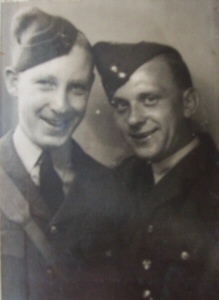 Edward Stanley Tompkins (L) with unknown airman. |
====
In September 2009 Mrs Jacqui Noble contacted Ron Ravenhall: "My name is Mrs Jacqui Ann Noble (née Coldicott). Coincidentally, I lived in the Rugby area from 1967 to 1988 and both my daughters attended Rugby High School for Girls. I read with interest on the then 207 Squadron RAF Association website your story of The Bent Sixpence – the story of the Dick Hawkes’ crew, 13 May 1943. You may be interested to know that it is the crew of my father’s Lancaster ED418 EM-G which you describe.
For many years my mother corresponded with Joan Hawkes, who lived in Cambridge and I believe was the sister of WD Hawkes, the pilot. Since my mother died, I have been trying to piece together information concerning my father, Flt Lt Albert Douglas Coldicott DFM who lost his life five months before I was born.
I found newspaper cuttings of National Press coverage of the first RAF awards for gallantry in air fights over Norway in which my father was awarded the DFM, together with a photograph of him receiving this honour from King George VI.
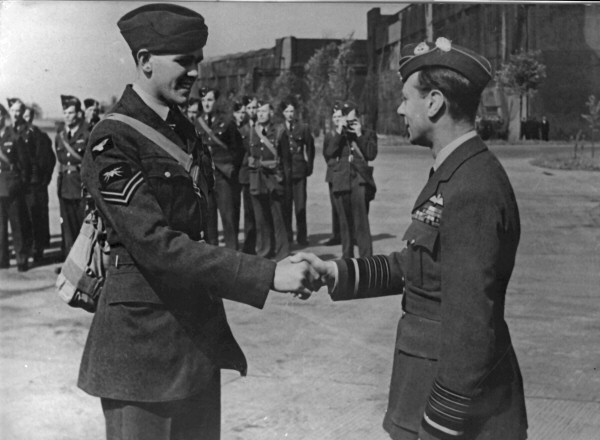
Albert Douglas Coldicott DFM with King George VI: source Jacqui
Noble
I found my father’s medals, my mother’s wedding dress, the bridesmaid’s head-dress and most of their wedding presents unused in a locked trunk in the house where she lived from 1939 until she died in 2000.
I also found the following documents:
A telegram confirming AD Coldicott missing as a result of operations on
night of 12/13 May 1943.
An official letter from RAF Station Langar confirming that my father was
missing as a result of air operations over Holland.
A letter dated 21 May 1943 confirming the names and addresses of the
Lancaster’s crew who were missing in action:
Fl.Lt. A.D. Coldicott DFM (airgnr)
Sgt. H.R. Dick (navigator)
P.Off. W.D. Hawkes (pilot)
Wt.Off.II. W.A. McNair (wop/airgnr)
(Interestingly, WA McNair was named as Canadian, Sgt WA Mohair Prisoner
of War, in Alan Cooper’s book The Air Battle of the Ruhr)
Sgt. G.R. Nipper (navigator)
Sgt. J. Smith (airgnr)
Sgt. E.S. Tompkins (fl.eng.)
Sgt. A.W. Whiteoak (navigator)
On 29 October 1943 the Air Ministry confirmed that 3 named and 4 ‘unknown’ airmen lost their lives on 13 May (as confirmed in an Official German Death List).
On 18 May 1944 the Air Ministry notified that the four unidentified members of the crew (including my father) were buried at Amersfoort in a communal grave, and my mother received a photograph from the Under Secretary of State for Air of the cross marking the grave at Rusthof Cemetery.
A letter to my mother from Greet Hagevoort, a Dutch lady who had adopted the grave of one of my father’s crew, describing the night of the crash and how the bodies were found.
A letter dated 14 September 1947 which was the first letter to my mother from René Swarts of Amersfoort, whose family had adopted the grave of ‘an unknown English flyer’. In this letter he explained that the Department of War had at last ‘found the identity’ of this flyer, Albert Douglas Coldicott. René Swarts explained that the graves were opened many times and the bodies in the communal grave had now been formally identified and were subsequently buried in individual graves. My father’s body was not officially identified until 1947 – four years after his death.
René explained in one letter that his family had had to go ‘underground’ for a long period due to the Jewish persecution. My daughter Sarah, who still lives in Rugby, sent me the article published in the Rugby Observer on 2 April 2009 concerning your mother and her bravery in Holland during the war. A remarkable lady!
In 1947, my mother travelled to Holland on the SS Arnhem from Harwich to the Hook of Holland, to stay with the Swarts family in Amersfoort and visit my father’s grave in Rusthof Cemetery. René Swarts came to stay with my family in Worcester a year later. He kept in touch with my mother for 20 years, sending presents for my birthday and Christmas every year until we received a notification of his death aged 42 years in January 1967. He too is buried at Rusthof.
In May 2006, my husband and I visited Amersfoort for the first time. By absolute coincidence we arrived on Memorial Day and thanks to a Dutch police escort to get us there on time through the crowds we were able to join in the Service of Remembrance at Rusthof Cemetery. It was an extremely moving experience. Some of the Dutch families gave me flowers to put on the graves of my father and the other crew members and I was thanked profusely for the sacrifice made for their liberation. We spoke with several Dutch families and were so touched by their sincerity, young and old alike, who to this day recognise the sacrifices that were made on all sides.
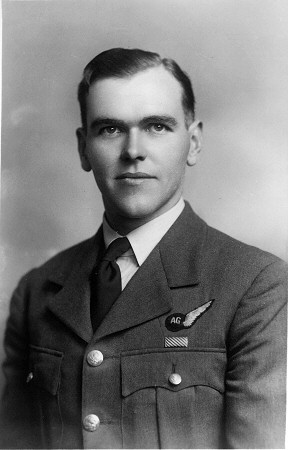
Albert Douglas Coldicott DFM: source Jacqui Noble
====
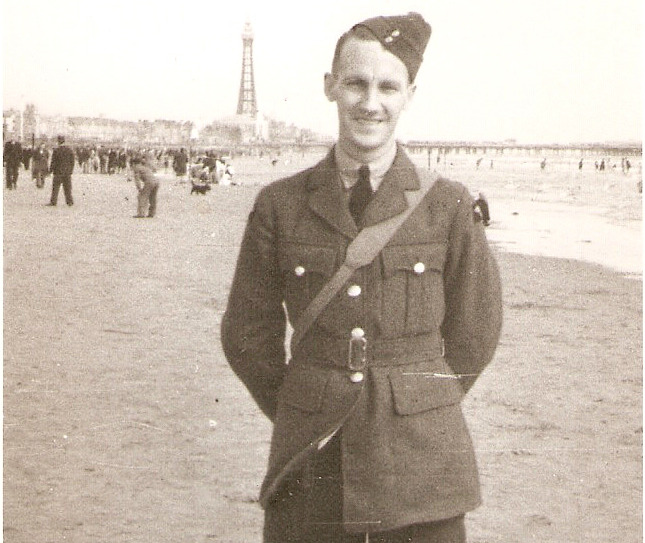
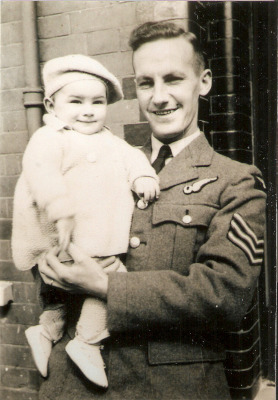
Here are two photos of Sgt George Robert Nipper, the Bomb
Aimer: one on the beach at Blackpool, presumably when training; one with
his son Ray when now Sergeant aircrew, he had received the coveted
Observer badge.
These have been provided by his sister-in-law via a neighbour who is
doing some research on him for her:
 |
 |
====
On the same raid, and just North of Amsterdam a 51 Squadron Halifax crashed. All the crew were killed. They are commemorated on a memorial 1000 metres from their crash site. The memorial, close to the North Holland Canal, also commemorates another 207 Squadron crew which crashed 300 metres from the memorial on 9 April 1943 and a Liberator crew which crashed on 6 March 1944, 750 metres from the memorial.
====
In 2009 Alfred de Vries from
Hilversum made contact. He is a member of two veterans organisations in
the Netherlands. He says that ED418 EM-G exploded more or less in the
backyard of where he has lived since 1960. Some damage is still visible.
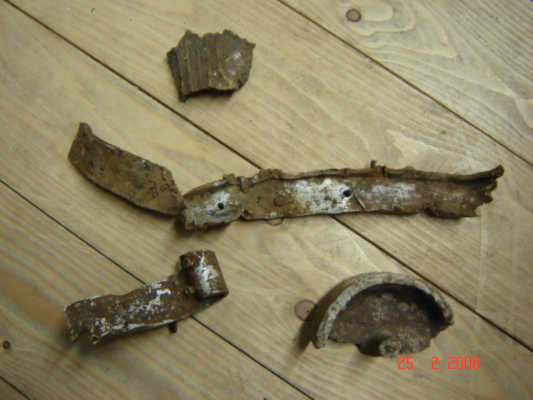
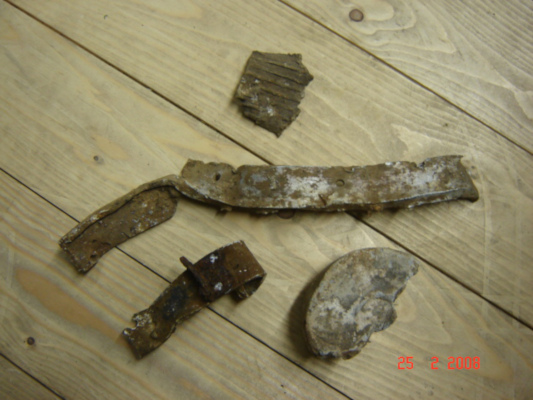
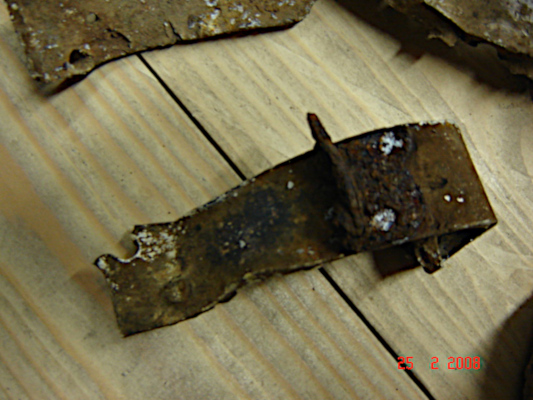
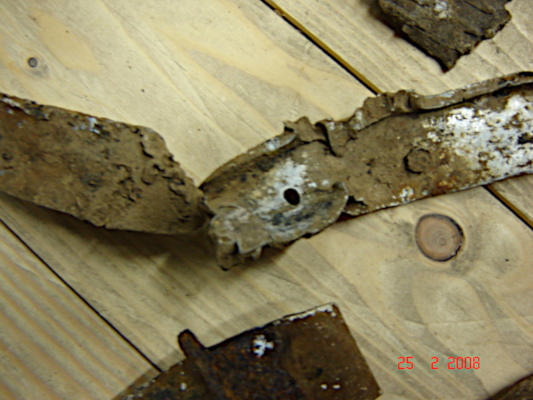
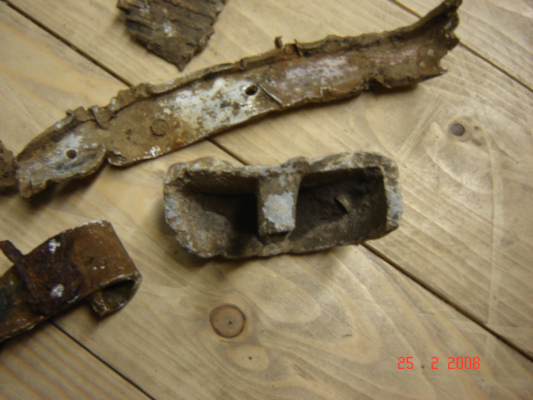
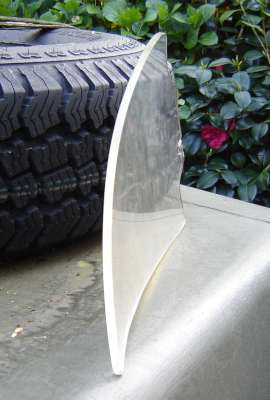
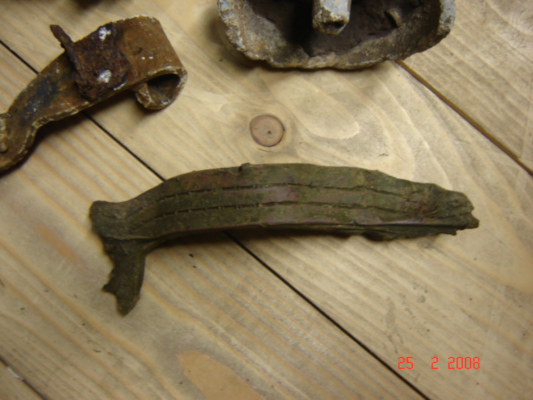
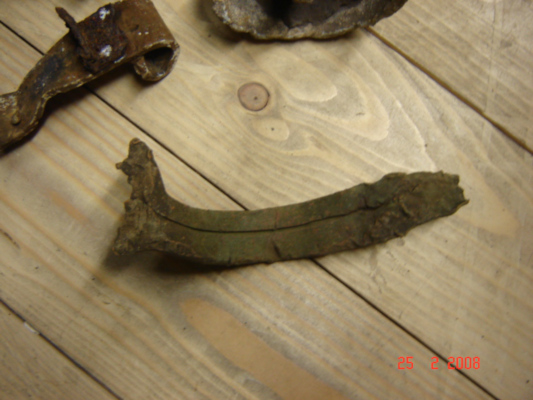
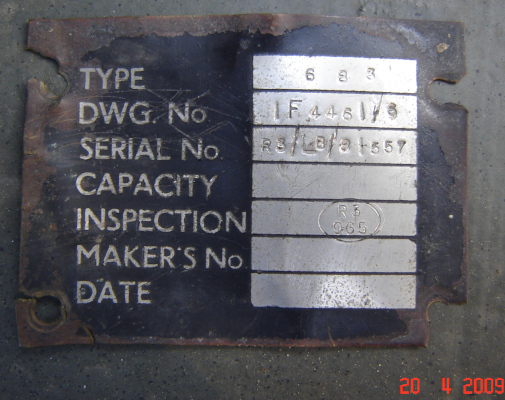
A friend has some items from the crash site and others have been
recovered from eye witnesses!
The plexiglass piece is rounded all directions, and there is one
man-made curve (the one on top). Alfred thinks it may be from a gun
turret. The images below are paired where possible to show items and
when the are turned over:
 |
 |
 |
 |
 |
 |
 |
 |
 |
If you have further information on the Hawkes crew (or on any of the Halifax crew), please contact the editor, Frank Haslam
page last updated 8 May 2010: 4 Jan 14: 18 Nov 17: 31 Dec 18: 7 Jan 19